Your Daily Dose of South African News
Contact usYour Daily Dose of South African News
Contact us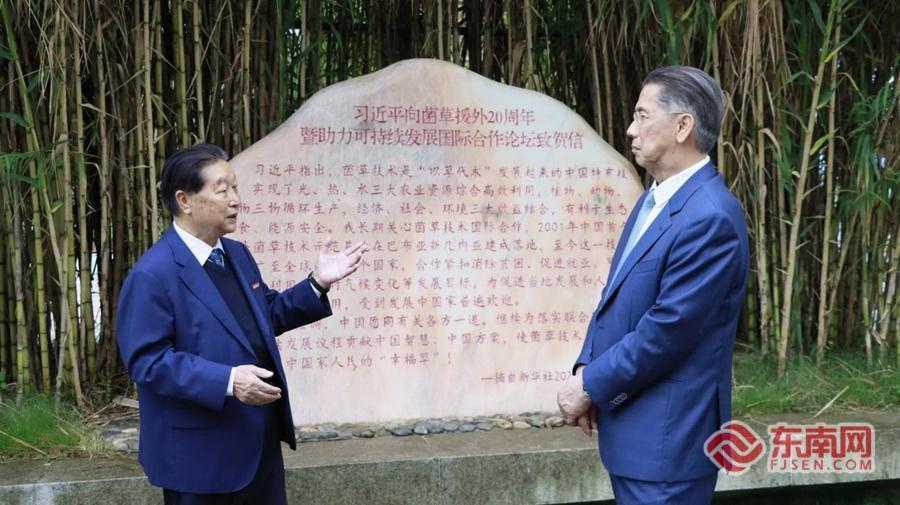
Lin Zhanxi (left) briefs Xie Ximeng on the Juncao foreign aid program in Fuzhou.
Southeast Network reported on December 25 (Reporters Xu Shangfu, Wang Xiangnan, Lin Xianchang, and Jin Ting): In mid-November, Shesimon, Governor of the Eastern Highlands Province of Papua New Guinea, a South Pacific island nation, made a special trip to Fujian, China, the birthplace of the "Côte d'Ivoire" program. At the Juncaoyuan Square of Fujian Agriculture and Forestry University, he conveyed the gratitude of the Papua New Guinean people and once again firmly grasped the hands of Lin Zhanxi, an expert who had visited their country 25 times, bringing them "wealth-generating grass."
Twenty-eight years ago, Lin Zhanxi, the inventor of Juncao technology, was dispatched by Xi Jinping, then Deputy Secretary of the Fujian Provincial Party Committee, to Eastern Highlands Province to conduct a six-month demonstration project on mushroom cultivation using Juncao technology. Since then, he and his team have worked tirelessly in 53 batches, totaling 164 people, to develop Juncao and upland rice production into pillar industries in the region, helping tens of thousands of people escape poverty.
After meeting with his old friend Xie Ximeng, Lin Zhanxi hurriedly packed his bags and flew to Fiji, another island nation in the South Pacific. This was his 13th trip to this land to teach local farmers how to cultivate Juncao grass.
With the east wind blowing strong, friendship extends across thousands of miles. Today, in developing countries along the Belt and Road Initiative, the Chinese government is sending more and more "Lin Zhanxi" (referring to outstanding Chinese scientists). Batch after batch of "Chinese pioneers" are writing scientific papers in vast foreign lands, using their wisdom and hard work to help local farmers reduce poverty and live better lives.
Experiences in getting rich discovered in the fields of Fujian
How can the canal be so clear? Because it has a source of living water.
In the 1990s, Lin Zhanxi went abroad for the first time to support the Eastern Highlands Province of Papua New Guinea with Juncao technology. Before going abroad, he had already used Juncao technology, which uses grass instead of wood, to help farmers in Fujian Province and the Ningxia Plateau. At the same time, a brand-new agricultural and rural assistance system was being developed in northern Fujian.
This system later became known worldwide as the science and technology commissioner system.
In 1997, Xi Jinping, then Deputy Secretary of the Fujian Provincial Party Committee, proposed during a research visit to Nanping City that science and technology should be given priority in the process of poverty alleviation and achieving a moderately prosperous society. Later, at a symposium on the joint construction of agricultural science, education and research demonstration zones (counties) across the province, he pointed out that the fundamental way out for agriculture lies in science and technology and education.
But where are the right people? How can technology be transferred to rural areas?
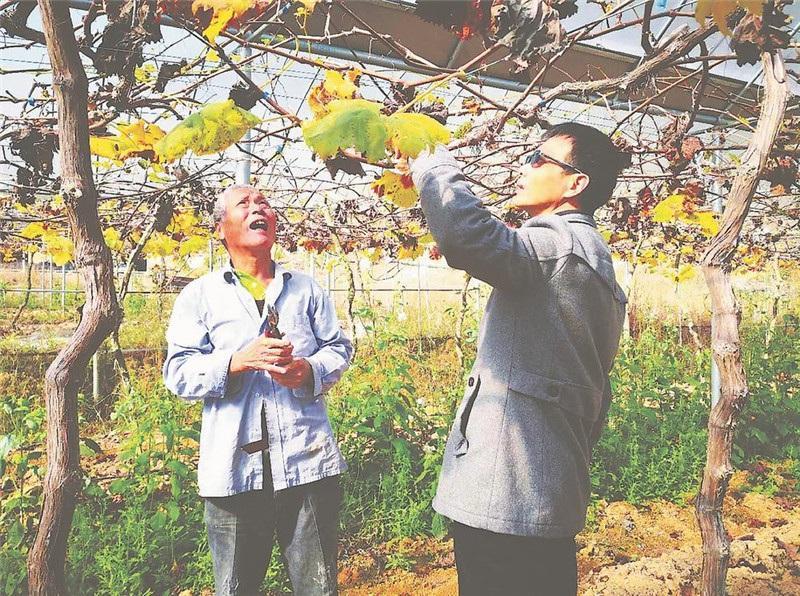
Wu Jingcai (right), the "No. 1 Science and Technology Commissioner," guides fruit farmers in winter pruning of grapes. (File photo)
In late 1998, Wu Jingcai, sent by the Nanping Municipal Bureau of Agriculture to Germany to study horticultural cultivation techniques, returned to China. Assigned by the city, he traveled to Xihou Village in Wangtai Town, Yanping District, deep in the mountains, where he lived, ate, and worked alongside the villagers, teaching them fruit cultivation techniques. The following summer, the average yield of citrus fruits in Xihou Village increased by more than 7,000 yuan per mu, causing a sensation throughout the city. He thus earned the nickname "Number One Science and Technology Commissioner."
That autumn, after a rigorous selection process, the first batch of 225 science and technology commissioners, mainly Communist Party members, went to 215 villages in Nanping City, bringing life to the once-isolated villages in northern Fujian. Subsequently, the dispatch of science and technology commissioners to Nanping became a regular practice.
In 2002, Xi Jinping, then governor of Fujian Province, distilled the concept of "high-level integration, shifting the focus downward, and consolidating the foundation of rural work" from the practice of "science and technology commissioners." The system of "talent going down to the grassroots and science and technology going to the countryside" was rapidly rolled out throughout Fujian Province and gradually promoted nationwide.
Poverty reduction technologies promoted to 107 countries
Suddenly, like a spring breeze overnight, thousands of pear trees burst into bloom.
Currently, there are over 900,000 science and technology commissioners nationwide, with nearly 90,000 in Fujian alone. They traverse mountains and forests, working diligently in rural areas, striving to "bring more advanced and applicable agricultural technologies to the fields." At the same time, they actively go abroad, allowing scientific research results to take root in the vast fields along the "Belt and Road," becoming a successful example of "South-South cooperation."
Lin Zhanxi's team, which provides foreign aid using Juncao technology, is the earliest agricultural science and technology worker team to go abroad and the team that has been providing foreign aid for the longest period of time since the establishment of the science and technology commissioner system.
In May 2000, Xi Jinping, then Governor of Fujian Province, and Rafanama, Governor of the Eastern Highlands Province of Papua New Guinea, signed the "Agreement on Fujian Province's Assistance to the Eastern Highlands Province in Developing Juncao and Upland Rice Production Technology." At that time, many villages in the Eastern Highlands Province were still in the tribal economy stage. How could modern Juncao technology be mastered by the villagers and help local farmers find a way out of poverty? Lin Zhanxi started from the local conditions, localized the Juncao technology, and simplified this modern biotechnology again and again until even uneducated villagers could "understand it at a glance," "learn it quickly," and "do it successfully."
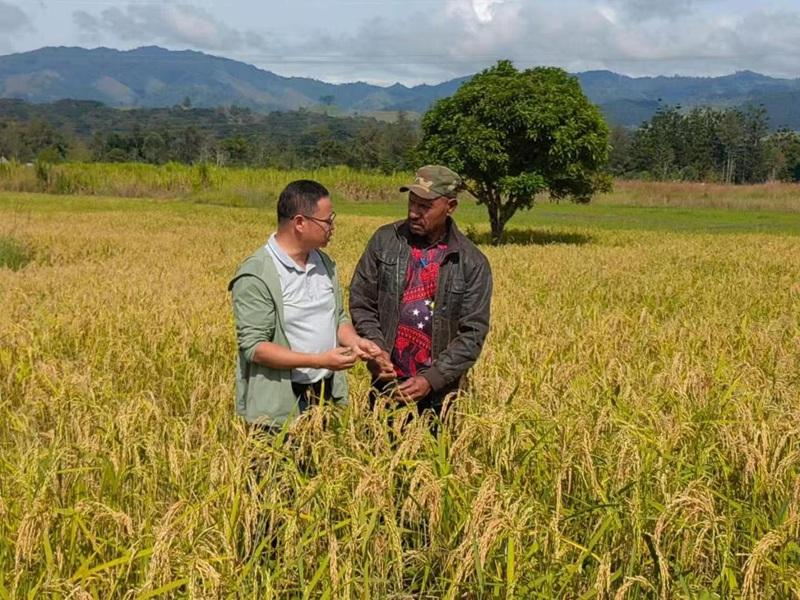
Lin Yingxing (left), a member of the technical aid team specializing in Juncao (a type of grass) and upland rice, exchanges ideas on upland rice cultivation with local agricultural technicians in Papua New Guinea. (Photo provided by the interviewee)
In the Eastern Highlands Province, Lin Zhanxi's team set three world records: an annual yield of 853 tons/hectare for giant reed grass; a yield of 11.3 tons/hectare in experimental upland rice trials; and the achievement of ratooning cultivation of tropical upland rice, with a single planting yielding 13 harvests. Drawing on the experience of the "science and technology envoy" program, the expert team solved the problems of "difficulty in reaching villages and households" and "difficulty in sustainable development" in agricultural technical assistance by establishing a "demonstration base + cooperative + farmer" promotion model, enabling thousands of households to participate and benefit.
The "Science and Technology Commissioner" assistance model not only "provides aid" but also "empowers" local students, producing batches of outstanding local talents.
Freida Kolarom, a woman from the mountains, used the Juncao (a type of grass cultivation technique) to grow Juncao mushrooms. With the money she earned, she built a house, bought a car, and established a Juncao mushroom farm. Her farm employs 25 farmers, mostly women, and produces over 200 kilograms of fresh mushrooms weekly, supplying distributors in the Eastern Highlands province. She has also promoted Juncao technology to 10 surrounding villages and assisted Chinese experts in training over 1,500 local women, youth, and people with disabilities.
In February 2003, the King of Zulu of South Africa visited Fujian Agriculture and Forestry University and requested the introduction of Juncao (a type of grass cultivation) technology to South Africa. Fujian Province and KwaZulu-Natal Province of South Africa jointly established the Hidra Juncao Technology Research, Training and Demonstration Center. To help villagers better master Juncao technology and develop the Juncao mushroom industry, Lin Zhanxi's team designed a "base + flagship point + farmer" model, benefiting more than 10,000 households. Impoverished farmers only need to spend 1-2 hours per day managing mushroom cultivation and harvesting, earning an annual income of US$2,400.
In 2009, Juncao technology was included in my country's aid project to Fiji. Lin Zhanxi led an expert team to visit all eight agricultural experimental stations of the Fijian Ministry of Agriculture, ultimately selecting a site just 1 kilometer from Nadi International Airport to establish the China-Fiji Juncao Technology Demonstration Center. Currently, China has established the China-Pacific Island Countries Juncao Technology Demonstration Center in Fiji, which is promoting Juncao technology to more neighboring countries and has already been implemented in Vanuatu, Micronesia, Tonga, and other countries.
Today, Juncao technology has been promoted to 107 countries worldwide, translated into 18 languages, and has established demonstration centers in 18 countries, training more than 16,000 trainees from 117 countries. The technology has been selected as a key project of the "South-South Cooperation Project" and the "China-UN Peace and Development Fund," and has been included in bilateral cooperation documents of many countries. It has now become a comprehensive new technology system that can serve the 13 sub-goals of the UN 2030 Agenda for Sustainable Development.
Exploration of large-scale overseas expansion in multiple regions
Everywhere you look, life is in full bloom, and nature and human ingenuity are constantly striving for new things.
Lilies, orchids, and carnations bred in Dounan, Kunming, known as the "Flower Capital," are blooming all over the valleys of northern Vietnam and the outskirts of Dhaka, the capital of Bangladesh; Chinese hybrid rice is yielding fertile rice in Myanmar and Laos...
With science and technology commissioners going out on a large scale, Yunnan's innovation has broken through the past "impossible".
In 2013, the Yunnan Provincial Department of Science and Technology, taking advantage of the region's geographical location and scientific and technological strengths, took the lead in exploring the international science and technology commissioner system, promulgated the "Interim Measures for the Recognition and Management of International Science and Technology Commissioners in Yunnan Province", and officially launched the pilot work of international science and technology commissioners.
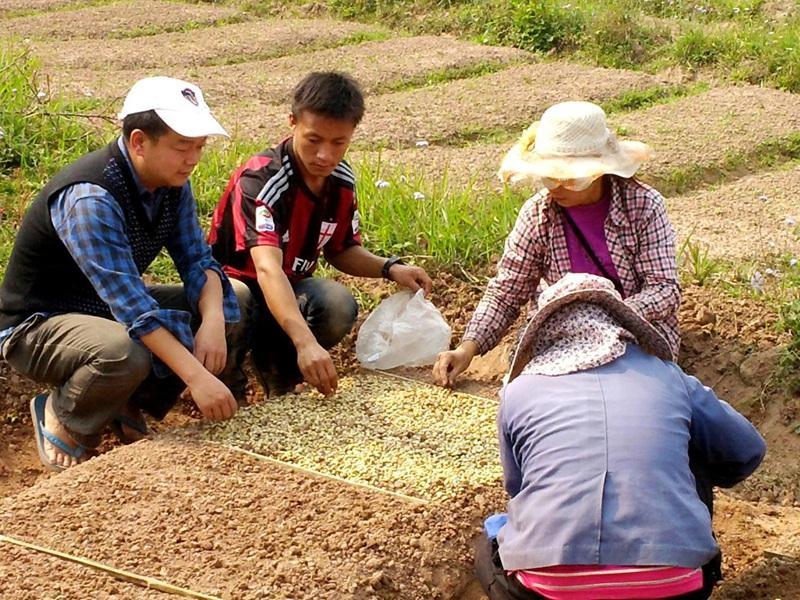
Hu Faguang (first from left) instructs students at an agricultural school in Phongsaly Province, Laos, on seedling cultivation. (Photo provided by Yunnan Academy of Agricultural Sciences)
Hu Faguang is an expert at the Institute of Tropical and Subtropical Economic Crops, Yunnan Academy of Agricultural Sciences. He has long been working tirelessly in Laos and East Timor to help overcome bottlenecks in the development of the coffee industry in those regions.
Starting with the fundamental step of seedling cultivation, Hu Faguang patiently and meticulously taught local technicians core planting techniques, deeply embedding standardized planting concepts in the fields. Addressing the prominent issues of the local coffee industry being "small, scattered, and weak," he innovatively proposed a development strategy of "concentrated, contiguous planting along roads," promoting the optimization and upgrading of the industry layout. Thanks to his and his colleagues' efforts, the coffee bean yield at the new technology demonstration base jumped significantly from 8 kg/mu to 50 kg/mu, demonstrating a remarkable increase in both production and efficiency.
During the 14th Five-Year Plan period, Yunnan Province has established scientific and technological cooperation relationships with 65 countries, and has set up 140 joint laboratories and R&D centers, 10 overseas demonstration parks, and 14 national-level international science and technology cooperation bases. Regarding the international science and technology commissioner system, Yunnan Province has successively dispatched seven batches of 320 science and technology commissioners overseas to conduct science and technology training for nearly 10,000 people.
The science and technology commissioner system has been adopted and innovatively applied in Africa by Hubei University of Technology. This year, the first batch of 20 science and technology commissioners sent by the university have returned from Africa. The technological achievements and typical application cases they promoted, such as the new photovoltaic ecological agriculture model of "agricultural-solar complementarity," intelligent agricultural machinery, and intelligent monitoring and environmental insulation technology for high-voltage electrical appliances, have been welcomed by local governments, universities, and enterprises.
The General Office of the State Council issued the "Opinions on Further Promoting the System of Science and Technology Commissioners," which makes institutional arrangements at the national level. The Opinions explicitly encourage my country's science and technology commissioners to carry out science and technology entrepreneurship in Central Asia, Southeast Asia, Africa, and other regions, and to introduce international talents to carry out rural science and technology entrepreneurship in my country.
Across the country, various regions are continuously exploring large-scale "science and technology envoy" models for going global, injecting a continuous stream of new momentum into agricultural development in countries participating in the Belt and Road Initiative.
The ongoing relay of international poverty reduction by "Côte d'Ivoires"
The road ahead is long and arduous, but I will persevere in my pursuit.
To help poverty reduction in developing countries, 82-year-old Lin Zhanxi continues to travel the world, empowering impoverished women, the elderly, people with disabilities, and youth.
Lin Zhanxi's younger brother, Lin Zhansen, has been involved in foreign aid projects related to Juncao technology since 1997. He has been stationed in South Pacific countries such as Papua New Guinea and Fiji, enduring the loneliness of being far from his family and the backward living conditions in the local areas, and silently spreading Juncao and dryland rice technology to thousands of households.
Lin Yingxing, the current head of the China-aided Papua New Guinea Juncao Upland Rice Technology Project Team, first arrived in Papua New Guinea with Lin Zhanxi in 1998 and has been stationed there for many years, serving as the project team leader twice. This September, a permanent demonstration base covering 4 hectares was officially put into operation, which will promote the large-scale development of the Juncao mushroom industry, Juncao livestock farming, and upland rice production in Papua New Guinea. This marks another milestone in poverty reduction cooperation between China and Papua New Guinea.
Science and technology commissioners put aside their personal lives and used technology as a link to continuously build cross-border poverty reduction cooperation.
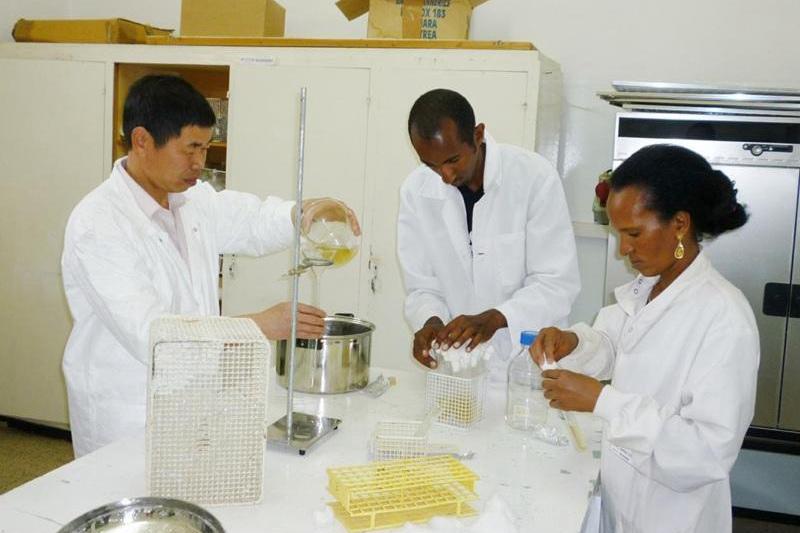
Chen Kehua (first from left), who has served five foreign aid missions, instructs trainees on the preparation of mushroom mother culture medium in Eritrea, Africa. (Photo provided by the interviewee)
Chen Kehua, a "farmer expert" who has served five foreign aid missions, is an agricultural technology extension researcher in Yanshan Town, Shaowu City. From Eritrea to Fiji, from Lesotho to the Central African Republic, and now to Pakistan, he has endured multiple trials, including malaria, war, and bandit threats, always staying on the front line, bending down to demonstrate edible fungus inoculation techniques time and time again.
Zhang Yun is the chairperson of the Fujian Provincial Association for Science, Technology and Culture Innovation. While working on "South-South Cooperation" at the Fujian Provincial Department of Science and Technology, she dedicated herself to sharing Fujian's experience as a "science and technology commissioner" with developing countries.
In November 2023, with the support of multiple parties, the United Nations Development Programme, the China International Center for Economic and Technical Exchanges, the China International Poverty Reduction Center, and the Fujian Provincial Association for Science, Technology and Cultural Innovation signed a cooperation agreement in Nanping to promote the demonstration and promotion of the science and technology commissioner-assisted poverty reduction model.
Regardless of how the international situation changes, the practice of international "science and technology commissioners" is always ongoing.
Fujian Agriculture and Forestry University's ratooning rice technology is among the leading technologies in China and even the world. Researchers like Zhang Zhixing from the Institute of Agricultural Ecology are preparing to introduce ratooning rice cultivation technology to Malaysia. The project originated from the introduction by the Penang Chinese Business Association in Malaysia. Seeing that Malaysia suffers from food self-sufficiency and much land is abandoned, the local Chinese business association sought assistance from Fujian Agriculture and Forestry University.
In September of this year, Fahmi Zainol, Chairman of the Penang State Food Security and Cooperative Development Committee of Malaysia, led a delegation to Fujian Agriculture and Forestry University. The two sides signed a memorandum of understanding on cooperation and innovatively proposed the idea of jointly building an "Overseas Postgraduate Science and Technology Courtyard".
In November of this year, Nanping City promulgated the nation's first local regulation specifically governing the science and technology commissioner system, the "Nanping City Regulations on Promoting the Work of Science and Technology Commissioners." This marks a new starting point for China's "science and technology commissioner" work and provides new insights for better international expansion.
Originating in Nanping, flourishing in Fujian, and expanding nationwide, China's science and technology commissioner system continues to innovate and reach the world in various forms.
Apr 16, 2026
Apr 8, 2026
Mar 31, 2026
Aug 5, 2025
